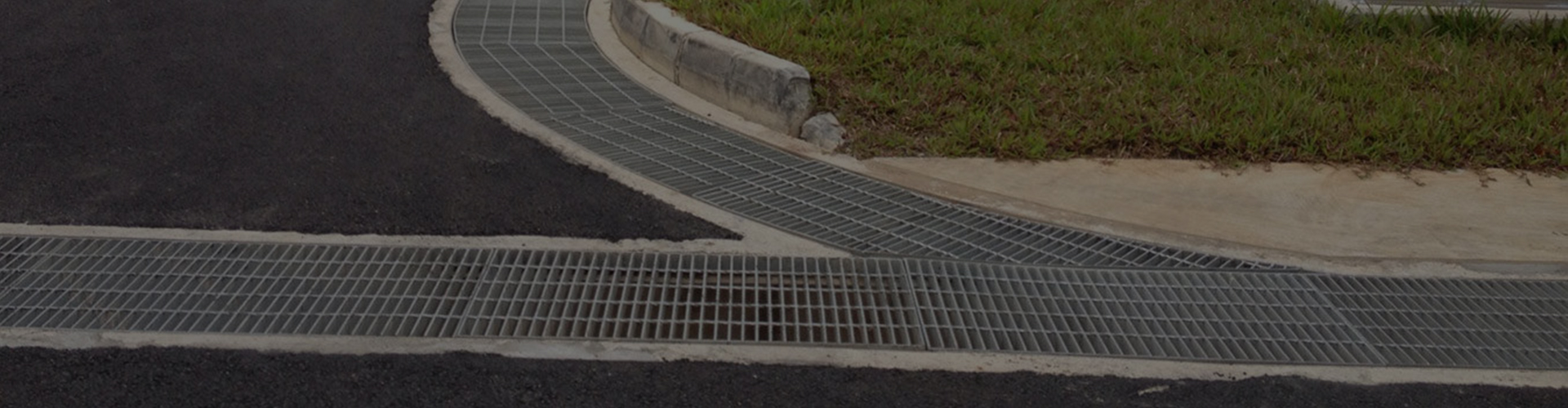
Trench Drain Grating
Trench Drain Grating is an important drainage facility component, mainly used in various construction and engineering occasions. Its main function is to remove stagnant water, keep the environment dry, and prevent debris from entering the drainage system.
As an expert trench drain grating manufacturer, we offer durable drainage solutions for efficient water management.
Our Trench Drain Grating Product Range
We supply three primary categories of trench drain grating, each targeting a different environment and performance requirement:
1. Galvanized Steel Trench Drain Grating
Hot-dip galvanized mild carbon steel bar grating fabricated to fit standard and custom trench channel widths. The most widely used and cost-competitive option for the majority of trench drain grating applications in industrial, road, and general infrastructure settings.
2. Stainless Steel Drain Grating
Stainless steel trench drain grating provides inherent corrosion resistance through its chromium oxide passive layer — no external coating required, no risk of coating failure exposing base metal. It withstands cleaning chemicals (caustic soda, chlorinated cleaners, phosphoric acid) that would attack zinc coatings, and it maintains a clean, professional appearance indefinitely with regular washing.
3. Metal Drain Grating — Custom Fabrication Service
For projects requiring non-standard dimensions, bespoke slot patterns, heel-safe or ADA-compliant close spacing, angle iron frames, or special locking mechanisms, our metal drain grating fabrication service produces trench drain grating to your exact drawing specifications.
Selecting the Right Product
Understanding Load Classes for Trench Drain Grating
The single most important specification decision for any trench drain grating project is the load class. Specifying the wrong class — even with the correct material and dimensions — will result in premature deformation or structural failure under traffic loading.
The internationally recognized standard is EN 1433 (European Standard for Drainage Channels for Vehicular and Pedestrian Areas). Load classes range from A15 (lightest) to F900 (heaviest):
| Load Class | Max Test Load | Typical Application |
|---|
| A 15 | 15 kN | Pedestrian and cycle areas only (parks, residential walkways) |
| B 125 | 125 kN | Light vehicle areas — car parks, residential driveways |
| C 250 | 250 kN | Roadside channels, service roads, slow-moving vehicles |
| D 400 | 400 kN | Carriageways, public roads, vehicle loading bays |
| E 600 | 600 kN | Aircraft aprons, docks, container ports |
| F 900 | 900 kN | Aircraft taxiways, military and extreme-duty applications |
Grate selection should always match the load class to the anticipated traffic — pedestrian, light vehicle, or heavy commercial — with clip-in or bolt-down fastening options chosen according to security and accessibility requirements.
For industrial plant projects: Process plant drainage channels that will be crossed by forklifts require D400 minimum; heavy fork truck traffic (>10 tonne rated capacity) should be specified to E600. A forklift applying 30,000 lbs across four tires, with an 8× dynamic load safety factor applied, requires a grate capable of carrying 60,000 lbs — which corresponds to a Class D rating under EN 1433.
Selecting the Right Material: Galvanized vs. Stainless Steel Trench Drain Grating
The most common decision procurement teams face is whether to specify galvanized steel or stainless steel trench drain grating. Here is a practical comparison:
| Factor | Galvanized Steel Trench Drain Grating | Stainless Steel Drain Grating (SS304/316) |
|---|
| Base material | Mild carbon steel (ASTM A36) | Stainless steel 304 or 316 |
| Corrosion protection mechanism | External zinc coating (sacrificial) | Passive chromium oxide layer (inherent) |
| Suitable environments | Outdoor, industrial, road, port — moderate corrosion | Food, pharma, marine, chemical — high corrosion |
| Chemical resistance | Limited — zinc attacked by acids and strong alkalis | Excellent — withstands most industrial cleaning agents |
| Hygiene / cleanability | Adequate for industrial drainage | Excellent — no crevices, smooth surface, food-safe |
| Appearance | Functional metallic finish | Bright, professional, aesthetically neutral |
| Service life (outdoor) | 25–40+ years (with 600g/m² zinc coating) | 50+ years (no coating to fail) |
| Relative cost | Lowest | 3–5× galvanized steel |
| Best choice when... | Corrosion risk is moderate, cost is a constraint | Hygiene, chemical resistance, or appearance is primary |
Decision rule: If your trench drain will collect anything other than clean surface water — food processing effluent, chemical washdown, salt water, dairy liquids — specify stainless steel. If it's outdoor surface water drainage in an industrial or civil environment, galvanized steel provides the right performance at the most economical cost.
Get a Quote for Trench Drain Grating
To receive a specification confirmation and competitive price within 24 hours, provide:
Material: Galvanized steel or stainless steel (SS304 / SS316)
Channel width (internal clear width in mm or inches)
Grate length (standard 500/1,000mm or custom)
Load class required (A15 / B125 / C250 / D400 / E600)
Bar type: Flat / serrated / close-mesh
Slot width preference (if specified)
Quantity (number of grates or linear metres of channel)
Destination port and country
Any compliance standard (ASTM, BS, AS, EN, etc.)

Frequently Asked Questions
Q:What is the difference between trench drain grating and a standard steel grating panel?
A:Both use the same bar grating construction (bearing bars + cross bars, pressure-welded), but trench drain grating is specifically dimensioned to fit the internal width of a drainage channel and designed to sit at or slightly below the surrounding surface. It carries both drainage function and surface load simultaneously. Standard floor grating panels are not load-rated to EN 1433 drainage channel standards and are not designed for the precise fit tolerances of a channel installation.
Q:What load class do I need for industrial forklift traffic?
A:For standard counterbalanced forklifts (5–10 tonne rated capacity), D400 trench grating is the minimum specification. For heavy reach stackers or container-handling equipment, E600 should be specified. Always apply a safety factor to the calculated wheel load — typically 2× for pneumatic tires, 8× for solid rubber or steel tires due to dynamic loading.
Q:Can you supply galvanized trench drain grating to fit an existing channel system?
A:Yes. Provide us with the internal channel width (measured at the grate seating), the required grate length, the bearing bar orientation preference, and your existing frame type. We fabricate to these dimensions — trench grating is always custom to the channel installation, not a standard panel product.
Q:How do I clean and maintain steel trench drain grating?
A:Galvanized trench grating: Periodic hose-down to remove sediment; inspect zinc coating annually in corrosive environments. No painting required unless the zinc has worn through at contact edges. Stainless steel drain grating: Regular wash-down with appropriate cleaning agents for the application (food-grade cleaner in food areas, pressure wash in industrial areas). No maintenance coating required. Both types can be lifted and reseated easily for channel cleaning — supply us with your channel specification and we can recommend the right locking or clip mechanism.
Q:Do you supply complete trench drain systems or grating only?
A:Our primary supply is trench drain grating (the cover component). We do not manufacture polymer concrete or HDPE channel bodies. We can supply grating with integrated steel angle frames and anchor bars that bond into the concrete installation — contact us to discuss your system requirements.
Q:What is your minimum order for trench drain grating?
A:We supply from single container load quantities (approximately 18–22 tonnes). For smaller project quantities, sample panels can be arranged before bulk order commitment. Contact our export team with your project scope.