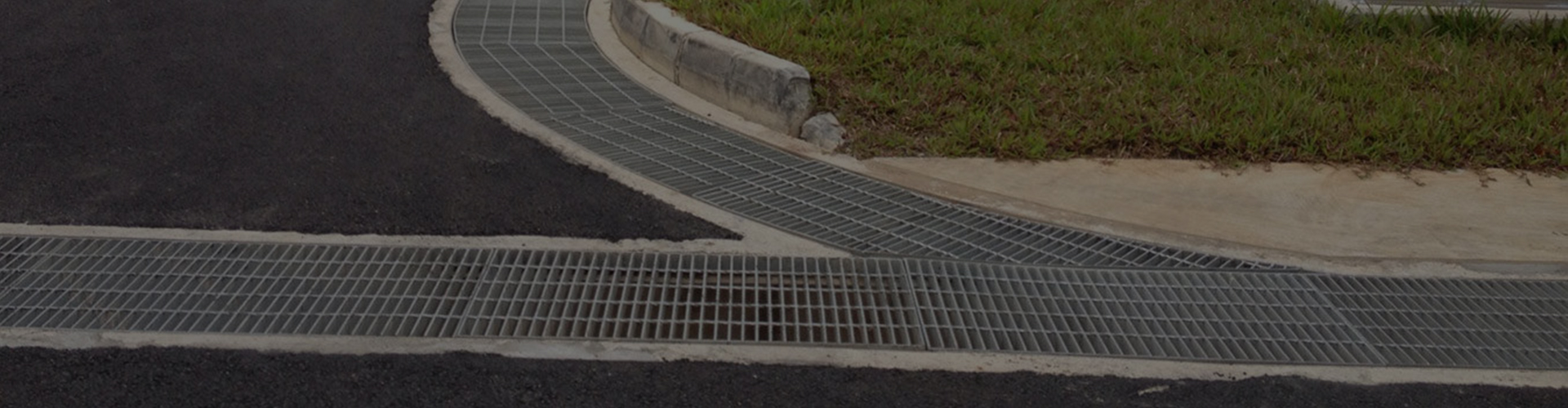
1) Optimized Draining Design: Water draining area amounts up to 83.3%, which is equal to twice of the cast iron product.
2) Hot-dip Galvanization: Strongly rust-proof, need no maintenance and replacement within 30 years.
3) Anti-theft Design: The cover and the frame are connected with chains, which is anti-theft, safe and easy to open.
4) Saving investment: Cost less than cast iron product in the case of large span and heavy load, and can save expenses incurred by replacement of stolen or crushed cast iron covers.
5) High Strength: Much higher strength and ductility than cast iron and applicable to environments of large span and heavy load such as docks and airports.etc.
6) Various Types: Can meet different environment,load,span and shape requirements, and can be customized based on provided size and shape.
Metal Types for Trench Drain Grating
Choosing the right metal is the most consequential specification decision. Each material performs differently under load, in corrosive environments, and over time. Canri supplies the following metal trench drain grating materials:
Galvanized Steel Trench Drain Grating
Hot-dip galvanized carbon steel is the most widely specified metal trench drain grating material for industrial and commercial applications worldwide. A hot-dip galvanized grate receives a zinc coating of 85μm or greater per ASTM A123, forming a sacrificial barrier that prevents the underlying steel from corroding.
Best for:
Industrial plant floors, workshop drainage channels, factory wash bays
Parking garages, commercial parking lots, loading dock drainage
Roadside drainage, highway runoff channels, municipal street drainage
Any environment with regular water exposure but no sustained chemical or chloride contact
Advantages: Lowest cost among corrosion-resistant options; decades of proven service life in standard industrial environments (40–50+ years in non-aggressive conditions); high structural strength; available in welded bar grating, press-locked, and solid plate slot styles.
Limitations: Not suitable for sustained exposure to chlorides (road salting, seawater, coastal salt air), strong acids or alkalis, or environments requiring sanitary cleanability (food processing, medical).
Metal Types for Trench Drain Grating
Choosing the right metal is the most consequential specification decision. Each material performs differently under load, in corrosive environments, and over time. Canri supplies the following metal trench drain grating materials:
Galvanized Steel Trench Drain Grating
Hot-dip galvanized carbon steel is the most widely specified metal trench drain grating material for industrial and commercial applications worldwide. A hot-dip galvanized grate receives a zinc coating of 85μm or greater per ASTM A123, forming a sacrificial barrier that prevents the underlying steel from corroding.
Stainless Steel Trench Drain Grating
Stainless steel trench drain grating in grade 304 or 316 is the premium choice for environments where hygiene, chemical resistance, and long-term appearance are non-negotiable requirements.
Cast Iron and Ductile Iron Trench Drain Grating
Cast iron and ductile iron metal trench drain grating provides the highest load capacity available in a drain grate format. These materials are specified for the most demanding vehicular environments where galvanized or stainless steel bar grating cannot sustain the impact and compression loads involved.
Aluminum Trench Drain Grating
Aluminum trench drain grating provides a lightweight, inherently corrosion-resistant option for environments where steel weight is a structural constraint or where non-magnetic, non-sparking properties are required.
Open Area and Hydraulic Drainage Capacity
The open area of a metal trench drain grating — expressed as a percentage of the total grating panel area — directly determines how much water can flow through it per unit of time. A grate with 15% open area will accept significantly less flow than one with 55% open area at the same head pressure.
General open area ranges by grating style:
| Grating Style | Typical Open Area | Best For |
|---|
| Open bar grating (welded, wide pitch) | 50–85% | Industrial drainage, high-flow applications |
| Close-pitch bar grating (ADA) | 30–50% | Pedestrian areas requiring ADA compliance |
| Slot plate (longitudinal slots) | 25–40% | Vehicular areas, highway drainage |
| Perforated plate | 15–35% | Sanitary environments, food processing |
| Ductile iron bar grating | 30–60% | Municipal, heavy vehicular drainage |
How to calculate required open area: The total flow capacity of a trench drain system equals: channel cross-section flow rate × open area fraction. If your drainage engineer has specified a required flow rate in GPM or L/s per linear meter, Canri's technical team can calculate the minimum open area required for your trench width and grating style.
Load Class Selection Guide (EN1433 / AASHTO)
Load class is the single most critical specification for metal trench drain grating safety. Undersized grating in a vehicular environment will fail — often catastrophically — when overloaded. Always specify the load class appropriate for the maximum load that will ever cross the grate, not just the typical load.
Canri recommendation: Always apply a dynamic load multiplier. A vehicle in motion generates 25–50% higher effective load than its static weight. A forklift rated at 5,000 kg creates an effective dynamic load of 6,250–7,500 kg when moving. Select the next load class up from the calculated static load for any application with moving vehicles or equipment.