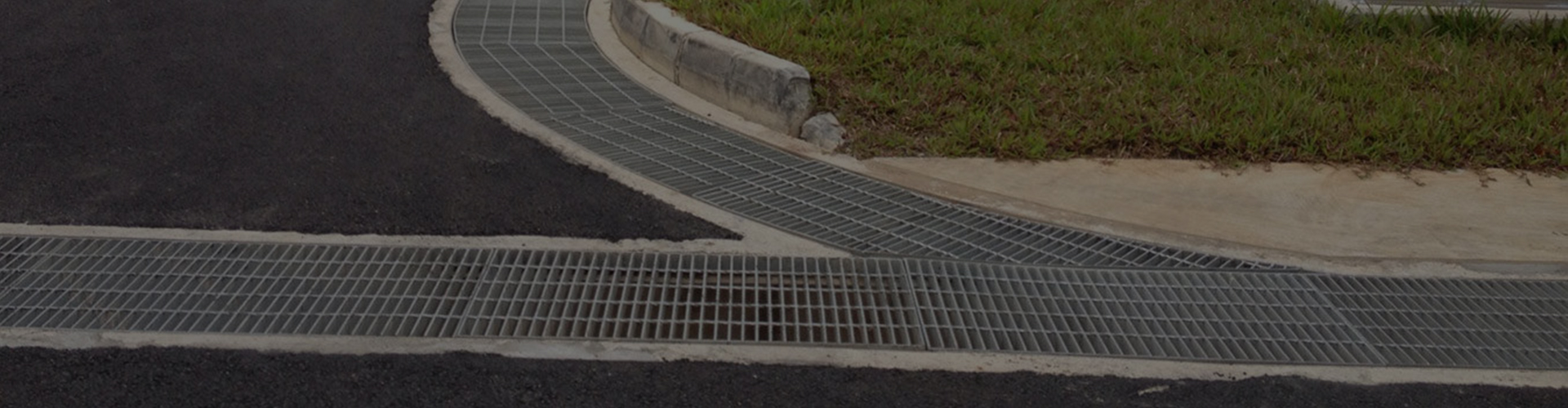
Industrial: Platforms, walkways, catwalks, and mezzanines in factories, oil refineries, and power plants.
Commercial:Stair treads, drainage covers, and security grilles.
Public Infrastructure: Bridges, trench covers, and subway ventilation.
Architectural: Decorative facades, sunshades, and fencing.
Why Galvanized Steel Grating Outperforms Alternatives
vs. Untreated (Black) Steel Grating
Untreated mild steel grating is lower cost at point of purchase but corrodes rapidly in any outdoor or humid environment — requiring repainting every 2–5 years and replacement within 10–15 years in corrosive settings. Galvanized steel grating in a moderate outdoor environment will typically provide 25–40 years of service life with zero maintenance. The lifecycle cost comparison almost always favors galvanized by a significant margin.
vs. Electro-Galvanized (Zinc-Plated) Steel Grating
Electro-galvanizing applies a thin zinc layer (typically 5–25µm) through an electrochemical process. It produces a smoother, more uniform surface but with a fraction of the corrosion protection. Electro-galvanized grating is appropriate for indoor, controlled environments only. Hot-dip galvanizing creates a zinc-iron alloy coating of 45–85µm or more; a Z600 coating (42µm per side) can achieve a service life of up to 80 years. For any outdoor, coastal, or industrial environment, hot-dip galvanizing is the correct specification.
vs. Painted or Powder-Coated Steel Grating
Paint and powder coating provide excellent initial appearance but are surface coatings with no metallurgical bond to the steel. Any scratch, impact, or edge cut exposes bare steel, which then corrodes under the coating. Hot-dip galvanized steel corrodes at a rate of approximately 1/30 of bare steel in the same environment, and the zinc coating provides sacrificial cathodic protection even at areas where the coating has been damaged. For any structural grating application in an outdoor or industrial environment, hot-dip galvanizing provides a more reliable and lower-maintenance protective system than paint.
vs. Stainless Steel Grating
Stainless steel grating offers superior corrosion resistance in chemically aggressive environments (chloride-heavy marine zones, food processing acids, pharmaceutical cleanrooms) but at 4–6× the material cost of galvanized mild steel. For the majority of industrial and infrastructure applications — where the environment is outdoor, humid, or mildly corrosive rather than chemically aggressive — galvanized steel grating delivers equivalent functional performance at a fraction of the cost.
Compliance Standards & Documentation
Canri's hot dip galvanized steel grating is produced to the following internationally recognized standards:
Grating fabrication: YB/T 4001.1-2007 (China) · ANSI/NAAMM MBG 531 (USA) · BS 4592 (UK) · AS 1657 (Australia)
Galvanizing quality: ASTM A123/A123M · BS EN ISO 1461:2022 · AS/NZS 4680 · GB/T 13912
Steel material: ASTM A36 · GB 700-88 · BS 4360-43A · AS 3679
Documentation available on request: Mill certificates (material test reports) · Hot-dip galvanizing inspection certificates (coating weight per ASTM A123) · Dimensional inspection reports · Third-party inspection support (SGS, Bureau Veritas, TÜV)
All documentation is provided in English and prepared to meet import-market procurement requirements.
Frequently Asked Questions
Q:What is the difference between hot dip galvanized and electro-galvanized steel grating?
Hot-dip galvanizing submerges finished steel panels in molten zinc at ~450°C, creating a metallurgically bonded zinc-iron alloy coating of 45–85µm or more. Electro-galvanizing deposits zinc from solution at room temperature, producing a thinner coating (5–25µm) with significantly less corrosion protection. For outdoor, industrial, or coastal environments, hot-dip is always the correct specification. Electro-galvanizing is only appropriate for indoor, controlled environments.
Q:How long does hot dip galvanized steel grating last?
Service life depends on the environment. In a moderate outdoor atmosphere (C2–C3 per ISO 9223 — suburban or light industrial), a 85µm zinc coating will typically last 30–50 years before requiring any maintenance. In aggressive coastal or industrial environments (C4–C5), expect 15–25 years. Galvanized grating in a sheltered indoor environment can last the lifetime of the building.
Q:What zinc coating weight does Canri supply as standard?
Our standard hot-dip galvanizing specification produces a coating weight of ≥600g/m² (≥85µm), which meets or exceeds the requirements of ASTM A123, BS EN ISO 1461, and AS/NZS 4680 for structural steel grating. Higher coating weights can be specified for particularly aggressive environments.
Q:Can you supply galvanized steel grating to Australian standard AS 1657?
Yes. We manufacture grating to AS 1657 with pressure-welded (electro-forge) construction and hot-dip galvanizing to AS/NZS 4680. Full documentation including galvanizing certificates and mill certs is provided as standard for Australian market shipments.
Q:Do you offer serrated bar galvanized grating as a standard product?
Yes. Serrated bar galvanized steel grating is a standard product line with the same specification options as flat bar. The serrations are machined into the bearing bars before galvanizing, so the zinc coating fully covers all surfaces including serrated edges.
Q:What is the minimum order quantity?
We supply from single container load quantities (approximately 18–22 tonnes depending on bar specification). For sample panels before bulk order commitment, contact our export team — we can arrange sample shipment or include sample panels in a test order.
Q:Can you fabricate custom panels with cutouts and banding?
Yes. Custom fabricated galvanized steel grating with cutouts, notches, curved edges, banding (flat bar border frame), and non-standard dimensions is available from our in-house fabrication team. Fabricated panels are galvanized after fabrication to ensure complete zinc coverage on all cut and welded surfaces.
Request a Quote for Galvanized Steel Grating
To receive a competitive quote within 24 hours, provide us with:
Required bar specification (bearing bar size × thickness, bar pitch, cross bar pitch)
Surface: flat bar or serrated
Panel dimensions (standard or custom/fabricated)
Quantity (weight or panel count estimate)
Destination country and port
Any compliance standard requirements (AS 1657, BS 4592, ANSI, etc.)
We supply project quantities and ongoing replenishment orders. Our export team responds to all RFQs within 24 hours.